Showing posts with label History. Show all posts

Thursday, June 24, 2010

De La O Genealogy

(An introduction of sorts)

Randy has invited me to post about various aspects of the De La O universe, and one of these strings will be dedicated to genealogy.

A small core of researchers in the extended De La O family has been working on the compiling of family trees and the determination of family origins and movement in the Americas. While most of the discussions have been taking place by private email, a few things have been posted here in Cafe De La O. By bringing together the various topics here into the blog-space, hopefully the range of interest will be expanded and contributions from others can be solicited in one place.

The one common ancestor of all the current researchers is our multiple-great grandfather, Pascual De La O (variants: Pascal, Pasqual, Pasquale), a fifth-generation ancestor for many of us, and his wife, Nicolasa Fernandes (variants: Nicolosa Fernandez, Nicolosa Hernandez).

Randy De La O is connected with the line of their son, Rafael De La O, while my line is through Rafael's brother, Buenaventura De La O.

We have evidence of ten children for Pascual and Nicolasa, and their descendants are much scattered. Slowly, we are piecing together the various family groups and tying together the lines, moving both forwards and backwards.

There are several interesting, orally preserved stories about various De La O relations, and because the historical remains are very scanty from Mexico and what was then Nueva Vizcaya (the area of the Southwestern United States), we are trying to collect these tales and also attempting to track down evidence. Future posts will touch on various aspects of these searches.

-


La Genealogía de la Familia De La O


Randy me invitó a que escriba sobre los varios aspectos de la familia De La O, y uno de temas será dedicado a la genealogía. Un pequeño grupo de investigadores en la familia De La O ha estado trabajando en los árboles genealógicos de la familia y los orígenes de la familia y de su movimiento en las Américas.

Mientras que la mayor parte de las discusiones han estado a través de email privado, algunas cosas se han publicado aquí en Cafe De La O. Reuniendo los varios asuntos aquí en el blog, esperanzadamente la gama de interés será ampliada y las contribuciones de otras se pueden solicitar en un lugar.

Un progenitor común de todos los investigadores es el abuelo de todos nuestros abuelos, Pascual De La O (variantes: Pascal, Pasqual, Pascuale), un progenitor de la quinto generación para muchos de nosotros, y su esposa, Nicolasa Fernandes (variantes: Nicolosa Fernández, Nicolosa Hernández).

Randy De La O está conectado con la línea de su hijo, Rafael De La O, mientras que mi línea está con el hermano de Rafael, Buenaventura De La O.

Tenemos evidencia de diez niños para Pascual y Nicolasa, y dispersan a sus descendientes mucho. Lentamente, estamos ensamblando a los varios grupos de la familia y atar juntas las líneas. Hay varias historias sobre la familia De La O, y porque los restos históricos son muy escasos de México y cuál era entonces Nueva Vizcaya (el área de los Estados Unidos al sudoeste), nosotros interesantes, oral preservados está intentando recoger estos cuentos y también está intentando rastrear evidencia. Los artículos futuros tocarán en varios aspectos de estas búsquedas.

(Apologías por la traducción española muy pobre.)

Wednesday, June 23, 2010

Buenaventura De La O

The following article on Buenaventura was originally published in the October, 1963 issue of New Mexico Magazine by Maria Abeyta Vasquez. . It's an interesting article and a valuable piece of family history. This article has been sent to me by several family members, most recently Joseph Valles, Buenaventura's great grandson. Both Mary De La O Kersey, Buenaventura's great granddaughter and Juanita De La O Gordon have also sent me this article.


Click on the images for a larger, more readable, version, click on it again for an extra large view


Wednesday, February 03, 2010

Civilian Conservation Corps - Death Valley National Monument: Set I

The following photos were taken by and of my father, Andrew Salazar De La O,  approximately 70 years ago during his time in the Civilian Conservation Corps in Death Valley, California. I believe these photos were taken with my father's old Eastman Kodak box camera. Some of the photos are of poor quality, still because of the content of these photos, they have both genealogical and historical value.


The handwritten caption on the back of the above photo,
 presumably written by my father, reads 
"This picture speaks for itself"


Above and below: My father Andrew S. De La O


My father Andrew S. De La O

Furnace Creek Camp-Death Valley


CCC, The Men, The Work, The Legacy


Saturday, November 17, 2007

History of the War With Mexico - John S. Jenkins

I have had this book in my possession for almost thirty years. My wife Jeri bought it for me at the old Pomona Gun Show at the Pomona Fairgrounds in 1979. It is of particular interest to me because it was through this war that my family became Americans. It is in reasonably good shape considering it was published in 1851 by Auburn, Derby and Miller Publishing Company. It has some old style personalized handwriting in it that adds to its character. I have other old vintage books but this one is my pride and joy. It is a small piece of history and for me, a physical link to the past.
There is a bit of trivia to go with this book. I have finally (today) solved the mystery of the handwritten names on in the book and I just find it amazing that this book was published in 1851, was a family possession for a number of years in the 1800's and then found it's way to me, and that 156 years later I have it.

There are three signatures on this book; Orry A. Taft Jr. May 25/59, Orray A. Taft Sr., (both middle names are Augustus). The third notation is, Augustus Reed Taft , from Grandma Taft, Oct 16, 1894. Grandma Taft is Elizabeth White, Orry Jr's. mother. Augustus is the son of Orry's younger brother, George Taft. So we know that the book was passed around the family a bit and was owned by at least three generations of the Taft family.

Orray (Orry) A. Taft Jr. was born in 1842. His parents are Orray A. Taft born in 1818 in Roxbury, Suffolk, Mass. and Elizabeth White Taft also born in 1818. They are both listed in the 1880 census as 62 years old and he is listed as a hotel proprietor . Orry married Lydia B. Edwards on April 24, 1879. Orry Jr. is listed in the 1880 census as 38 years old and living in Boston, Suffolk, Mass. His occupation is listed as starch manufacturer. He is living in his father in law’s household. His father in law is Edmund J. Baker.. At the time of the 1880 census they have no children, however also listed in the household are five children with the surname Edwards, presumably from a previous marriage of Lydia. The children’s names are Lydia B. Edwards 12, Mary E. . Edwards 10, Ellyn L. Edwards 8, Edmund B. Edwards 5 and Elizabeth R. Edwards 4. Also living in the household are four servants, three of them are from Ireland, and one of them was born in Mass. All of them are Irish. Presumably, the family was well off. It's amazing what you can find from a signature.


The complete name of the book is: The History of the War with Mexico from the Commencements of Hostilities to the Ratification of the Treaty of Peace.

(click on any photo for a larger view)


Above Photo: President Zachary Taylor


"The war with Mexico constitutes an episode, and by no means an unimportant one, in the history of the American Union. Its brilliant scenes and stirring incidents have long attracted unusual attention, and they must long continue to be remembered."
- Historian John S. Jenkins,1850

Addendum:
In 1808 Russell Sturgis bought rights to Point Shirley and in 1811 opened a salt works, which continued operation until about 1840. Orray Taft built his famous Taft’s Hotel and Restaurant in 1830 where Maryland, Townsend and Otis Streets are now. Following a fire in 1851, the main structure was rebuilt and the business flourished until 1889 when the remaining buildings were then used as The Point Shirley Club up through the 1920’s. A Greek Club/Restaurant then occupied the building until it was razed in the early 1950’s for house lots. A picture of the old Taft Hotel is provided below.


The following is from: History of the Military company of the Massachusetts now called the Ancient and honorable artillery company of Massachusetts, 1637-1888
by Oliver Ayer Roberts

Orray A Taft Jr 1877 manufacturer of Boston Mass and Providence R.I. son of Orray A and Elizabeth White Taft was born in Cornhill Coffee House now Young's Hotel June 26 1841 He married April 24 1879 Mrs Lydia Baker Edwards He spent his boyhood in Boston attended the Chauncy Hall School and completed his school education at Middleboro Mass Academy After leaving school he became a clerk for Thomas Liversidge starch manufacturer at Milton Mass Later he went into business on his own account as a manufacturer of gums and starch having offices in Providence R.I. and Boston Mass In the State militia he rose to the grade of lieutenant Lieut Taft 1877 was a member of the Masonic Fraternity being a member of Union Lodge of Dorchester from 1865 to 1872 and of Boston Commandery Knights Templars of Boston He died Feb 12 1889 and his remains were buried in the Milton Burial Ground Milton Mass

History of the Military Company of the Massachusetts, Now Called the Ancient ... By Oliver Ayer Roberts


Amazing what you can find from a signature.
Perhaps the descendants of Orray Augustus Taft will find this helpful.

Thursday, September 28, 2006

Paths of Services Meet on a Bloody Beach in the Pacific

Reprinted from Military.Com

Paths of Services Meet on a Bloody Beach in the Pacific
U.S. Coast Guard | PA1 Kyle Niemi | September 27, 2006

As America's two smallest armed services, the U.S. Marine Corps and the U.S. Coast Guard have much more in common than many may think.


It's not our uniforms or our haircuts; it's not our equipment or our training.

It's our history and our traditions; it's our honor and our commitment.

Both services were established to help protect a fledgling nation, vulnerable to enemies- both foreign and domestic. Both services are on the frontlines of today's global war on terrorism- with members fighting both at home and abroad. And both services are proud of our members who paid the ultimate sacrifice having been wounded or killed in defense of our country.

Bronze Stars, Purple Hearts and Medals of Honor adorn the gravesites of both Coast Guard and Marine Corps combat veterans.

THE BIRTH OF THE UNITED STATES MARINE CORPS - THE FEW. THE PROUD.

On Nov. 10, 1775, the Continental Congress passed a resolution raising two battalions of Marines to serve as landing forces in combat. This resolution established the Continental Marines, who saw action until the Treaty of Paris ended the Revolutionary War in 1783. The treaty resulted in the disbanding of the Continental Marines and Continental Navy.

The formal re-establishment of the Marine Corps was through an act of Congress on July 11, 1798.

THE BIRTH OF THE UNITED STATES COAST GUARD - GUARDIANS OF THE SEA

Immediately following the Revolutionary War, the United States government struggled to maintain financial stability. Although import tariff laws were in place, rampant smuggling by merchants transporting cargo by sea signaled the need for strong enforcement of maritime tariffs. On Aug. 4, 1790, Congress passed the Revenue Cutter Bill, authorizing the construction of 10 armed vessels, thus establishing the Revenue Marine. The Revenue Marine cutter crews were charged with enforcing the tariffs and other maritime laws and operated as the only armed federal vessels in the nation's service for nearly 10 years; the Navy Department was not established until 1798.

Officially known as the Revenue Cutter Service since 1862, the service was merged with the U.S. Life-Saving Service in 1915 to form the U.S. Coast Guard.

BROTHERS-IN-ARMS

Marines and Coast Guardsmen can share in some of the greatest tales of heroism and sacrifice from all of the armed conflicts of our nation's history. Perhaps the best depiction of Coast Guardsmen and Marines fighting side-by-side against a common enemy was during the turbulent days of World War II.

World War II, spanning from 1939 to 1945, was a worldwide conflict the likes of which the modern world had never seen. The conflict waged between the Allied and Axis Powers in the Mediterranean Sea and the Indian, Atlantic and Pacific Oceans. No less than 56 countries were involved in air, land and sea battles in Europe, the Soviet Union, North Africa and Asia's Far East.

According to news anchor Tom Brokaw, Americans who came of age during the Great Depression and fought for our country during World War II are the "Greatest Generation." Brokaw coined the phrase in his 1998 book of the same name.

With experience navigating small vessels in heavy surf, Coast Guard coxswains manned landing craft during the amphibious operations of World War II, delivering Soldiers and Marines to the beaches in both the Atlantic and Pacific theaters. Coast Guard crews also escorted convoys, transported troops and supplies, conducted port security operations and hunted enemy submarines.

THE ULTIMATE SACRIFICE

Guadalcanal, a small island in the Solomon Islands, would be the scene of a major turning-point in the war in the Pacific. Under Japanese control, the island was chosen as the location of the first large-scale assault of a Japanese-held island.

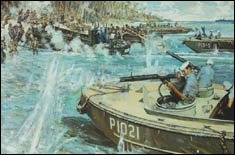
On Sept. 27, 1942, about a month into the Guadalcanal Campaign, about 500 Marines of Lt. Col. Lewis B. "Chesty" Puller's 1st Battalion, 7th Marines were huddled on the beaches of the Matanikau River awaiting extraction from the island. Petty Officer 1st Class Douglas Munro, coxswain of a 36-foot Higgins boat, was officer-in-charge of a dozen craft from Lunga Point Base arriving to extract the Marines.

Suddenly, Japanese forces began firing intensely from a ridge about 500 yards from the beach. Steering his boat between the Marines and the Japanese forces, Munro provided cover for the landing craft, allowing the safe evacuation of all the Marines, including 25 wounded.

Once all the Marines were safely extracted, Munro and his crewman maneuvered their boat to leave. It was then that Munro was struck by enemy fire and killed instantly. Munro was posthumously awarded the country's highest honor- the Congressional Medal of Honor. He remains the only Coast Guardsman to receive the medal.

The Coast Guard also engaged in transport and escort duties for Marine forces invading the islands of Guam, Tinian, Saipan, Okinawa and the Philippines.

As brothers-in-arms during the amphibious assaults and invasions of World War II's battle for the Pacific, the Coast Guard and Marine Corps each showed why they are considered the best in the world at what they do. It's been nearly two-and-a-half centuries since history saw the birth of the Marine Corps and the Coast Guard. From the turbulent first days of our country through the first and second world wars to today's global war on terrorism, the armed forces of the United States, including the Marine Corps and the Coast Guard, will continue to answer the call to service.